Let’s be blunt: most people who try day trading fail. Study after study points to the same reality — very few traders achieve consistent, long-term profits. This guide answers what percentage of day traders are successful, why headline numbers mislead, and what you can do to improve your odds with data, not hype.
How this guide differs: This is a statistics and survival guide — success rates, survivorship bias, and the five hurdles that filter most traders out. For mindset reading lists, see books about trading psychology. For simulating drawdowns from your stats, see the equity curve simulator. For daily process and review habits, pair this with why every trader needs a trading journal.
The unfiltered truth on day trader success rates
If you’re searching “what percentage of day traders are successful,” you want reality, not influencer promises. The dream of financial freedom is real — but success is not handed out. Trading is a high-performance skill that demands discipline, a tested edge, and emotional control under live pressure. It is a long-term endeavor, not a lottery ticket.
The statistics are stark. Research cited by Quantified Strategies found only about 13% of day traders stay consistently profitable over six months. FINRA-related data often cited in industry summaries suggests roughly 72% of day traders finish a year in the red. The most sobering figure: about 1% remain profitable for more than five years — building and keeping an edge is that hard.
A visual look at the odds
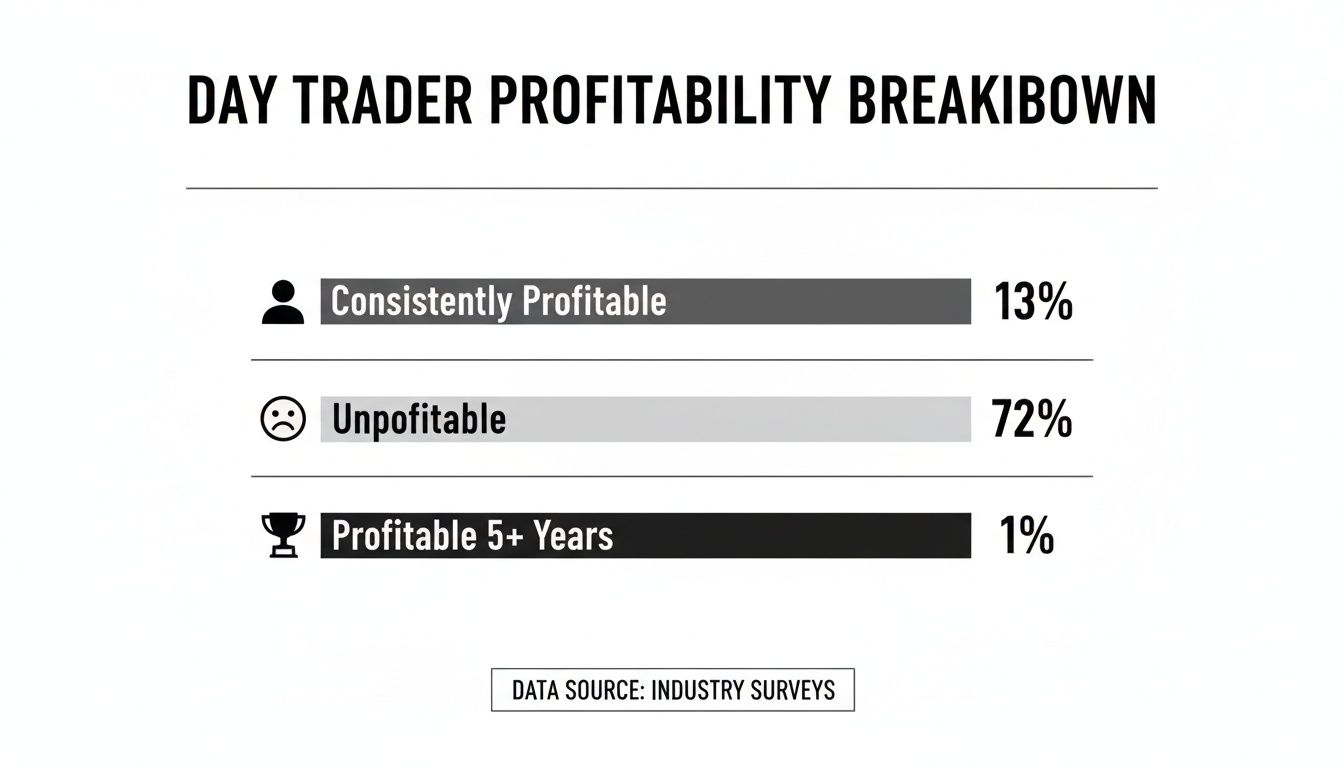
Most traders struggle. A small group finds intermittent success; only a tiny fraction achieves lasting profitability that could support a career.
Day trader success rates at a glance
| Statistic | Percentage or figure | Source highlight |
|---|---|---|
| Unprofitable traders (annual) | ~72% | FINRA / industry summaries |
| Consistently profitable (6 months) | ~13% | Quantified Strategies |
| Profitable over 5+ years | ~1% | Academic and brokerage studies |
| Fail within first year | ~80% | Broker platform studies (e.g. eToro) |
These numbers are not meant to scare you off — they ground expectations. Respecting the profession is step one toward joining the top percentile.
What does “success” even mean?
Headlines disagree partly because “successful” is undefined. One dollar of annual profit? A living wage? Beating the S&P 500?
Here we define a successful day trader as someone who generates consistent, meaningful profits for at least a year — enough to supplement or replace primary income. That bar puts you in a very small club.
The market is a mirror. Success is not a magic indicator — it is mastering yourself and your plan, day in and day out.
Knowing most fail forces better questions: What do the profitable few do differently? How do I build those habits? That shift moves you from lottery thinking toward professional skill-building.
Why day trading statistics can be so misleading
You’ve probably seen answers from 10% to 1%. Both can be “true” in context. One statistic is one frame of a movie — the goal is to understand what each study actually measured.

Different definitions of success
- Any profit: Account up $1 after a year counts as “success” in some datasets — not a living.
- Living wage: Consistent income replacing a job — a much smaller group.
- Beat the market: Outperforming buy-and-hold (e.g. S&P 500) — another, stricter bar.
The label changes with the standard, like comparing a casual gym visitor to an Olympic trainee.
Anyone can look successful for a quarter; lasting edge shows across thousands of trades and multiple regimes — bull, bear, and chop.
Timeframe and market conditions
Three months in a bull market flatters many traders. Five years through bull, bear, and chop reveals whether an edge is real. Short-term luck often disappears when conditions change.
Track your own consistency with how to calculate win rate — but remember win rate alone does not equal profitability without risk-reward and sample size.
Survivorship bias is powerful: we hear winners because losers quit quietly. Thousands who funded an account, lost quickly, and left are rarely in long-term studies.
Survivorship bias
Most research only sees accounts still active. It misses people who blew up in weeks and never returned. Studying only surviving startups would wildly overstate entrepreneurial odds — trading data often has the same flaw. Reported success rates frequently describe survivors, not everyone who ever tried.
Understanding that nuance lets you respect the field without panic — and focus on what it takes to be among the few who last.
The five hurdles that filter out most traders
Grim success rates are not random. Predictable internal challenges weed out the unprepared, undisciplined, and underfunded.
1. The emotional rollercoaster
The market amplifies fear and greed. Fear cuts winners short before they can pay for losses. Greed holds losers too long, hoping for a turnaround that rarely comes. Revenge trading after a loss — oversized, impulsive bets — is often the fastest path to ruin.
The plan may be sound; if you cannot execute when pressure spikes, the best strategy in the world will not save you.
2. The capital trap
Underfunded accounts turn every loss into catastrophe. Traders oversize hoping one win fixes everything; one bad trade can make recovery nearly impossible.
Professional traders often risk no more than 1% of account capital per trade. On a $5,000 account that is $50 — tiny to beginners who chase 10–20% bets and blow up.
Proper capital survives drawdowns so a statistical edge can play out. Without it, you are gambling on a clock. See risk management for traders for sizing and kill switches.
3. The strategy maze
Hopping from scalping to swing trading to guru signals prevents mastery. A real edge needs hundreds of logged trades: clear entry, management, and exit rules — not guesses.
4. The discipline breakdown
Discipline connects plan to results. Common leaks:
- FOMO — entering because a stock is ripping, not because setup criteria are met
- Impatience — forcing trades when nothing qualifies
- Moving stops — refusing to accept being wrong
Small rule breaks compound into large losses.
5. The burnout cliff
Day trading demands hours of focus and emotional control. Roughly 80% of traders quit within two years; nearly 40% leave after one month — often from mental exhaustion, not only P&L.
Protect mental capital: breaks after losses, boundaries outside the charts. Even strong traders fail when burned out.

A practical blueprint for improving your trading odds
Statistics are a filter, not your destiny. This blueprint reframes trading as a process-driven business — four pillars that separate systematic traders from gamblers.
Think like a business owner
Your trading plan is your business plan — detailed enough that another trader could execute it. Include:
- Goals — specific, measurable outcomes
- Market and session — what you trade and when
- Strategy rules — unambiguous entry and exit criteria
- Risk limits — per trade, day, and week; kill switches
- Review cadence — when you audit performance
Revise the plan when data says the process needs adjustment — not when emotion demands a new system.
Implement disciplined risk management
The 1% rule: never risk more than 1% of total trading capital on one trade. On $30,000, max loss per trade is $300 — five or ten losers in a row should not end the game. Capital preservation first, profits second.
Find and verify your statistical edge
Positive expectancy means winners, on average, outweigh losers over many trades. Prove it in two steps:
- Backtesting — rules on historical data to find flaws without capital risk
- Forward-testing (paper trading) — live conditions, real-time psychology, simulated money
Only then consider live size. For methodology, see how to backtest trading strategies.
Embrace a growth mindset
Every trade is data. Review wins and losses for patterns — especially emotional ones. That loop is where a trading journal earns its keep: accountability to the plan you wrote when calm.
How a trading journal becomes your secret weapon
The habit that separates many profitable traders from the crowd is not a secret indicator — it is meticulous record-keeping. A journal answers: Does my strategy work, and am I following it?
Without logs you fly blind on memory and gut feel.
Transforming data into a roadmap
A journal attacks the five hurdles directly:
- Strategy maze — which setups actually pay vs slowly bleed the account
- Emotional rollercoaster — repeated notes like “moved stop because scared”
- Discipline breakdown — boredom trades and rule skips visible in black and white
The market teaches; the journal makes lessons stick.
From manual notes to automated insights
Spreadsheets work; modern tools calculate win rate, session stats, and tags faster. You might find edge between 9:30–11:00 AM or consistent Friday losses — truths that only appear in data.
Your trading history is a goldmine. A journal extracts lessons from mistakes so you do not repeat them blindly.
For structure and fields, see what is a trading journal. Record, review, refine — the cycle does not change; better tools make it faster.
Your path toward the successful minority
Statistics map the battlefield — they are not a verdict on you. The profitable minority treats trading as a business: risk rules, process execution, every trade as a data point.

Large-scale analyses of active retail traders — including samples of 450,000+ accounts — often find under 1% consistently profitable after fees, with well over 90% failing to beat a simple index fund over time. That gap between hype and data is why process beats prediction.
Consistent profitability is not luck or genius. It is unwavering discipline, rigorous self-analysis, and tools that preserve a statistical edge.
Lasting success is not one life-changing trade. It is boring, repeatable execution: show up, risk within rules, treat every trade as a data point.
Stop hunting a holy-grail indicator. Start logging trades and turning experience into expertise.
Frequently asked questions about day trading success
Can you actually make a living from day trading?
Yes — but it is rare. Estimates often put 1–4% at consistent profitability needed for a living. That requires serious capital, a verified edge, and iron-clad daily execution. Treat it as a high-performance career, not a side hustle fantasy.
How much capital do I need to start day trading?
In the US, $25,000 is the pattern day trader minimum for stock margin accounts — but minimum is not sufficient. Trade only capital you can afford to lose without psychological pressure that forces oversizing.
Having enough to start is not the same as having enough to succeed. Professionals treat capital as their primary tool and protect it before chasing returns.
Does a trading journal guarantee success?
No tool guarantees market profits. A journal attacks the main failure modes: emotional decisions, unproven edges, and invisible rule drift. It is the most direct way to turn wins and losses into actionable improvement — especially paired with tags and periodic review in TraderSetup or your preferred system.
Related reading
- Why every trader needs a trading journal — turn stats into daily habits
- Risk management for traders — survive the capital trap
- Equity curve simulator — stress-test win rate and drawdowns
- Books about trading psychology — mindset for the emotional rollercoaster
- How to calculate win rate — measure consistency beyond headlines