In the fast-paced world of trading, it is easy to chase the next setup and overlook one of the most reliable tools for long-term success: a trading journal. Journaling is not about writing a diary for its own sake. It is a structured record of what you traded, why you traded it, and what happened — so you can learn from both wins and losses instead of repeating the same mistakes.
A trading journal is a log of every trade plus the decisions behind it. Traders use it to measure performance, spot recurring errors, and build discipline over time. If you are new to the concept, our guide on what is a trading journal covers the full definition and key components; this article focuses on why it matters and how to put the habit to work.
What goes wrong without a trading journal
Most traders can recall a losing streak that felt random — or a winning streak that felt like proof they had finally “figured it out.” Without a journal, those stories stay in memory, and memory is biased. You remember the one big winner and forget the five small losses that came before it.
Common problems when you do not journal:
- Revenge trading after a loss, breaking your rules to “get it back”
- Overtrading on volatile days because excitement feels like opportunity
- No feedback loop — you cannot tell whether a strategy works or you got lucky
- Confusing luck with skill, which leads to sizing up at the worst time
Discipline and risk control are not optional extras. They are how professionals survive long enough to compound an edge. Our guides on risk management for traders and what percentage of day traders are successful show how few traders succeed without process — and a journal is the simplest way to build that process.
Why every trader should keep a journal
1. Measure your performance over time
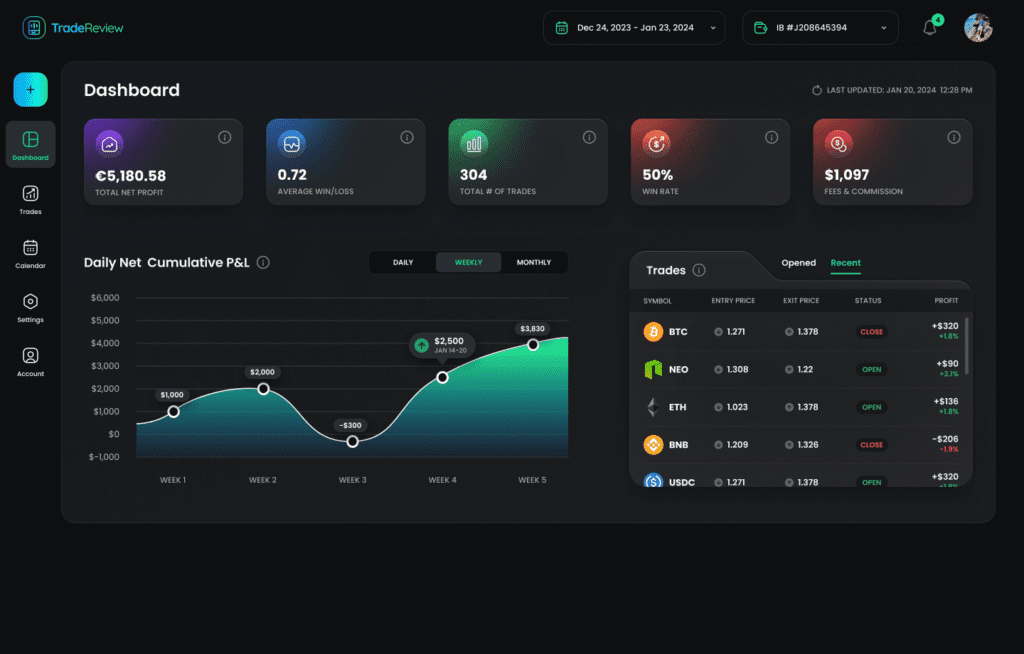
It is hard to improve what you do not measure. With a trading journal, you monitor each trade: entry and exit prices, position size, setup, and outcome. After dozens of trades, patterns become visible instead of anecdotal.
You can track:
- Profit and loss trends that show whether you are growing or drifting
- Win rate and average win/loss, for a realistic view of your edge — see how to calculate win rate for the math
- High-probability setups that repeat versus one-off luck
- Profit and loss by strategy or tag, so you know what to scale and what to cut — calculating trading profit helps you interpret the numbers
TraderSetup’s performance dashboard surfaces these metrics in one place, so you spend less time in spreadsheets and more time on decisions. After 50 or 100 logged trades, you can answer questions like “Does my morning session outperform the afternoon?” with data, not gut feel.
2. Manage emotions and stick to a plan
Trading is emotional. Fear, greed, and boredom drive impulsive entries, early exits, and rule-breaking. A journal creates distance: you write what you felt and what you did, then review it when you are calm.
Journaling helps you:
- Recognize triggers such as FOMO, frustration, or overconfidence
- See which emotional states correlate with losses
- Stay aligned with a written plan instead of improvising every session
Pair trade notes with your rules. Did you enter because the setup matched your checklist — or because the market “felt” hot? Did you exit at your target or bail early? Over time, these entries expose the gap between your plan and your behavior. For deeper reading on mindset, see books about trading psychology.
With TraderSetup’s notes on each trade, you can log emotional state and lessons next to the numbers, so review sessions stay concrete.
3. Gain confidence and build a path to success
Confidence in trading should come from evidence, not from one good week. A journal is your personal roadmap: each trade, tag, and note is a data point toward a repeatable process.
Custom tags let you group trades by setup (“break and retest”), market condition (“high volatility”), or behavior (“FOMO”). Filtering by tag shows which buckets actually pay. That is how you double down on what works and retire what does not — without guessing.
Broker import and auto-connection reduce manual entry so logging stays consistent even on busy days. Consistency matters more than perfection; a partial journal you maintain beats a perfect template you abandon.
What to record on every trade
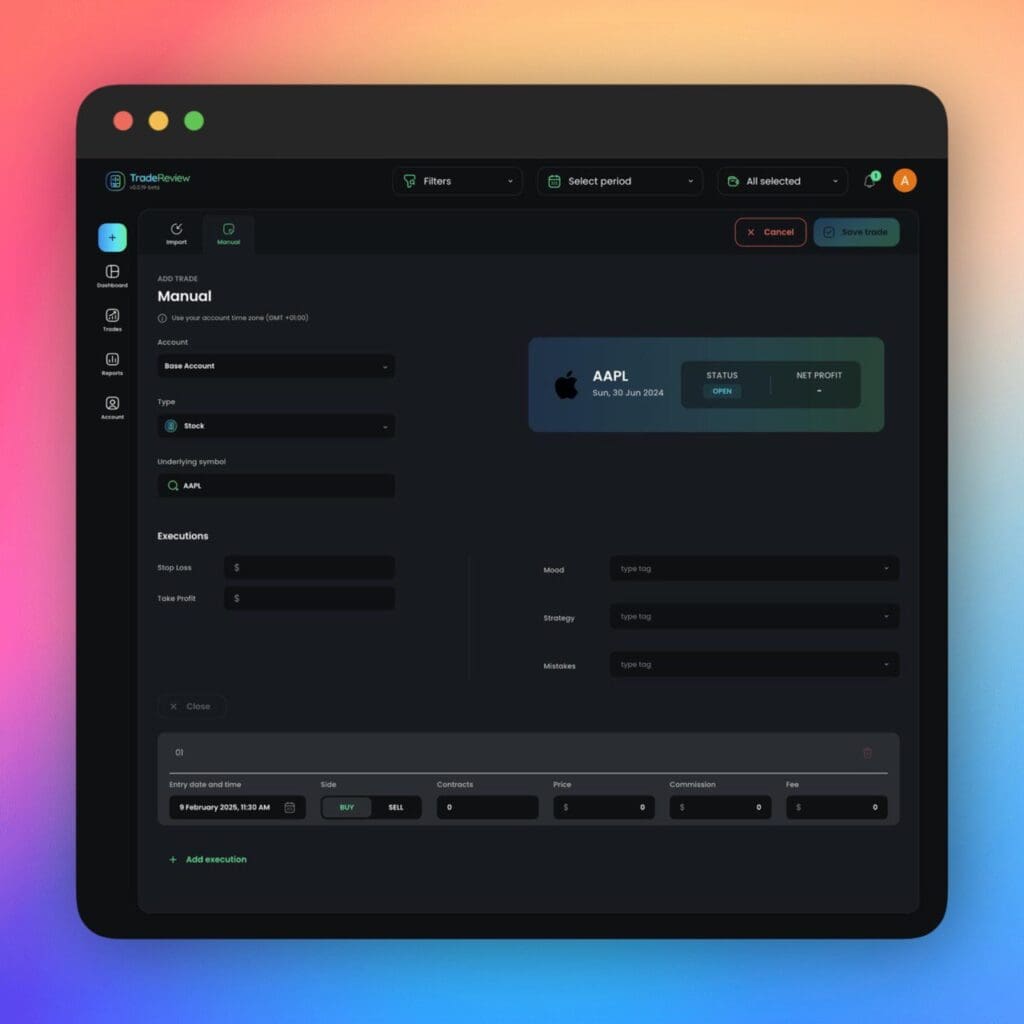
You do not need a novel for each entry. A short, repeatable checklist is enough:
- Date and time (entry and exit)
- Symbol, direction, and position size
- Entry and exit prices; net P&L
- Setup or strategy name (use the same labels every time)
- Whether you followed your plan (yes/no)
- Emotional state in one line (calm, anxious, revenge, etc.)
- One sentence: what you would do differently
For a full breakdown of journal sections — market context, risk, screenshots — see what is a trading journal. If you are building the habit from scratch, journaling for beginners walks through tools and routines.
How often to review your journal
Logging trades is step one; review is where improvement happens.
| Cadence | Focus |
|---|---|
| After each session | Log trades while details are fresh; note rule breaks immediately |
| Weekly | Spot patterns: repeated mistakes, best setups, days you should sit out |
| Monthly | Check win rate, drawdown, and tag performance; adjust size or rules |
Tie monthly reviews to risk metrics such as maximum drawdown and to your written trading plan template. The journal makes the plan real — you see whether you actually traded it.
Paper journal, Excel, or app?
There is no single best format — only what you will use consistently.
- Notebook — simple and distraction-free; you do the math and charts yourself
- Excel or Google Sheets — flexible and familiar; good for custom formulas. Start with our Excel trading journal or trading journal Excel template guides
- Dedicated app — faster logging, dashboards, tags, and broker sync. Compare options in best trading journal or try a free trading journal app if you want zero upfront cost
Many traders begin in Excel and move to an app when manual entry becomes the bottleneck. TraderSetup supports both CSV import and broker connections so you are not locked into one path.
Frequently asked questions
Do profitable traders still need a journal?
Yes. Profitability in a short window does not prove a durable edge. Journals show whether results come from a repeatable setup or from a few outsized wins — and whether risk is under control before a drawdown arrives.
How long before a journal helps?
You can learn from day one, but meaningful patterns usually appear after 30 - 50 trades in the same style. Stick with the same fields and tags so comparisons stay valid.
Is Excel enough for day trading?
Excel works well if you log every trade the same day and review weekly. Day traders who take many positions often switch to an app for speed and auto-import. Either way, the habit matters more than the tool.
What is the difference between a diary and a trading journal?
A diary is narrative and open-ended. A trading journal is structured around trades, metrics, and rules — designed for review and improvement, not only venting.
Should I journal paper trades?
Yes. Paper trading is the right place to test process and emotional discipline without capital at risk. Log paper trades with the same fields you would use live so habits transfer when you go live.
Next steps
A trading journal turns trading from a series of isolated outcomes into a business you can improve. Start with a simple checklist, log every session for a month, and review weekly before you change strategy or size.
Further reading:
- What is a trading journal — definition and components
- Journaling for beginners — build the habit
- Best trading journal — compare tools
- Excel trading journal — spreadsheet setup
- How to calculate win rate — core performance metrics
- Risk management for traders — protect capital while you learn
Ready to take your trading to the next level? Try TraderSetup for free today.